Shift handover agents for mining
The short version: the most expensive information on a mine site is spoken at shift change and never written down. A shift handover agent captures the outgoing crew’s knowledge by voice, structures it against your asset register, and gives the incoming supervisor a briefing that survives the roster.
Last updated:
The problem, precisely
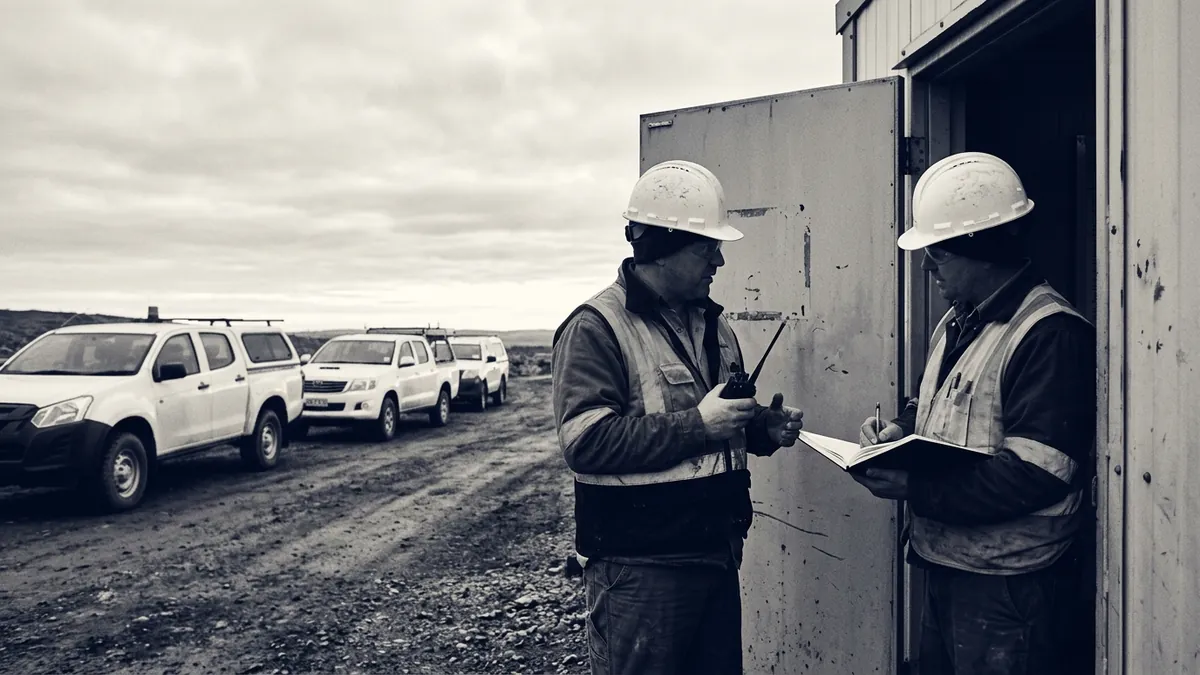
Ten to twenty minutes at crib or the muster point, verbal, unrecorded. What’s down, what’s been tried, which pump is running hot, what the client rep said, where the water is sitting after last night’s rain. The quality of that transfer depends entirely on who is handing over and how tired they are — and on a FIFO roster, the person with the context may be on a plane for the next two weeks.
When an incident investigation later asks what was known and when, the honest answer on most sites is that nobody can reconstruct it. The handover happened; the record doesn’t exist.
What the agent does
Capture. The outgoing supervisor talks — at the asset, in the ute, at the crib table. Three to five minutes of unstructured speech, on a device that works with gloves and without signal.
Structure. The agent maps what was said against your asset register and open work orders: which statements attach to the CV02 conveyor, which to the 785 fleet, which are safety observations, which are open actions carried from the previous shift.
Brief. The incoming supervisor gets a structured briefing before walk-on: what changed this shift, what remains open, what needs eyes first, and which items have been open across multiple shifts — the ones that quietly become incidents.
Escalate. Safety-relevant statements are flagged at the top, not buried in a summary. Anything matching your trigger words — isolation, guarding, ground conditions — routes to HSE as it’s captured, not at shift end.
Shift handover today vs with an agent
| Today | With an agent | |
|---|---|---|
| Capture | Verbal, 10–20 min, unrecorded | Voice, 3–5 min, structured |
| Consistency | Depends on the person | Same fields, every shift |
| Off-roster continuity | Breaks for two weeks | Holds |
| Multi-shift open items | Remembered, sometimes | Tracked until closed |
| Safety observations | Mixed into conversation | Flagged and routed |
| Incident reconstruction | Memory | Timestamped record |
Built for the conditions
Offline first. Pits, declines and camps drop signal. Capture queues locally and reconciles when coverage returns — this is the primary design assumption, not a fallback.
Voice, not typing. Nobody types a handover wearing gloves at 5:50am. If the capture is slower than the conversation it replaces, crews stop using it, and the data dies. We test this in shadow mode with your actual crews, PPE and background noise.
The conversation still happens. The agent captures and structures; it doesn’t replace the face-to-face. Crews that feel replaced stop cooperating, and how it’s introduced matters as much as how it’s built.
Not surveillance. The record is of operational status — assets, actions, conditions — not of people. That distinction has to be real and visible or adoption fails.
What it connects to
Maintenance: SAP PM, Maximo, Pronto, Mex, Fiix — open work orders are pulled into the briefing and voice-reported defects can raise notifications.
Rostering: so the briefing reaches whoever is actually walking on, including step-up supervisors.
HSE systems: safety observations route into your existing reporting, not a parallel system.
Where this fits with the rest of the site
The cross-industry pattern is described at shift handover and continuity; this page is the mining-specific build. The same capture layer feeds maintenance log agents and permit-to-work agents, and most sites deploy two of the three together after the audit.
Frequently asked questions
Will crews actually use it?
Only if it’s faster than what they do now — which is the design target and the first thing shadow mode tests. Three minutes of voice against a twenty-minute verbal ritual plus a paper log is the trade, and where it isn’t faster, we change the build rather than blame the crew.
Does it work underground or in the pit with no coverage?
Yes. Capture is fully offline-tolerant and reconciles on return to coverage. Sync payloads are small by design.
Is this recording people?
It records operational statements the supervisor chooses to make, at the moment they make them. It is not ambient recording, and we’d advise against building it that way even if asked — adoption dies with trust.
What happens to safety-critical statements?
They’re flagged at capture and routed to HSE immediately against your trigger rules. The agent never assesses risk itself; it makes sure a person sees it faster.
How long to deploy?
Typically 4–6 weeks including two weeks of shadow mode, assuming API access to your CMMS. The audit confirms feasibility against your actual systems in week one.