AI agents for after-hours call handling
Straight answer: this is consistently the most undervalued agent in any business, because nobody measures the calls they never received. Invoca’s call analytics across healthcare found that dental organizations miss 27% of inbound calls and hospitals miss 24% (Invoca) — and when callers reach voicemail instead of a person, fewer than 3% leave a message (Invoca). 88% of U.S. healthcare appointments were in-person in 2024 — meaning phone remains the dominant booking channel (Medical Economics / Zocdoc, December 2024). The same pattern holds in trades, storage and automotive.
Last updated:
What this actually looks like today
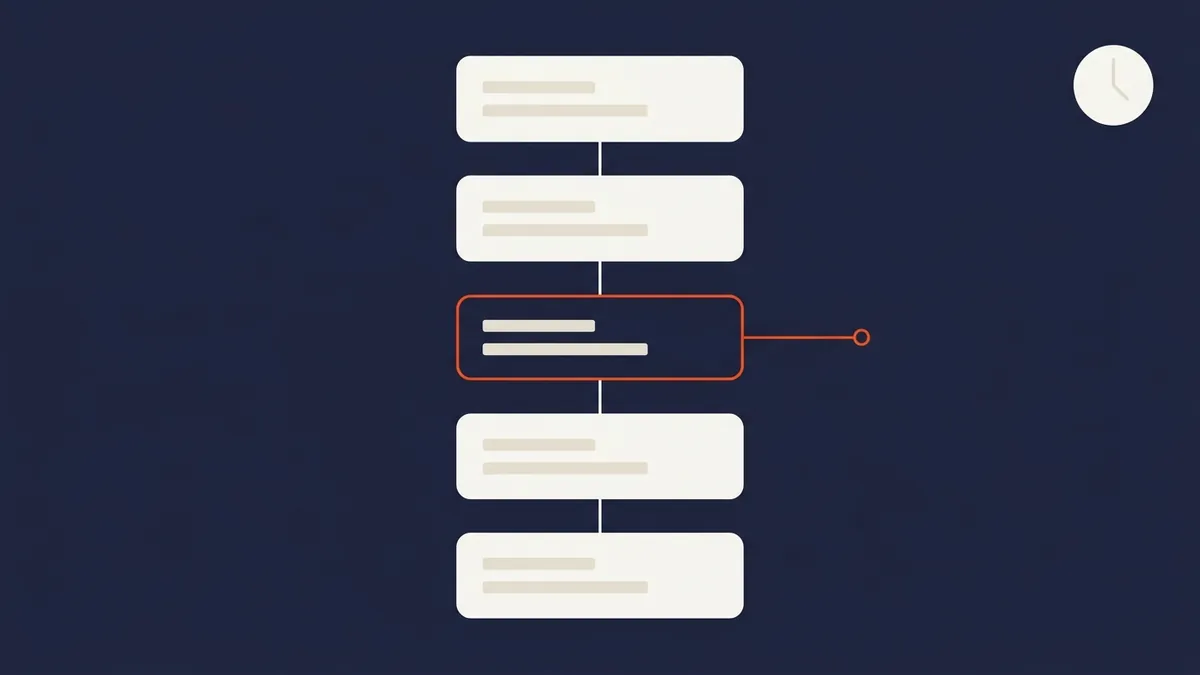
Someone calls at 7pm. They get voicemail. They hang up without leaving a message — most people do — and call the next number on the list. You never know it happened.
The version you do see is worse: the message left at 11pm, actioned at 9am, by which point the customer has already booked elsewhere. You count that as a lost quote. It was a lost call.
What the agent does
- Trigger. An inbound call outside staffed hours, or an overflow call when your team is already on the phone.
- Reasoning. Identifies the caller against your CRM, establishes what they need, applies your triage rules — is this an emergency, a booking, a query, a complaint — and checks live availability.
- Action. Books the slot in your actual calendar, confirms by SMS, creates the CRM record, and pages the on-call technician if the rules say so.
- Escalation. Anything emotionally sensitive, ambiguous, or outside its scope transfers to a human with the full conversation context — who’s calling, what’s wrong, what’s been said so far.
Traditional vs agent-augmented
| Moment | Today | With an agent |
|---|---|---|
| 7pm enquiry | Voicemail, then silence | Answered and booked |
| 11pm emergency | Answering service, partial detail | Triaged, on-call paged with full detail |
| Overflow during business hours | Ring-out or hold | Answered immediately |
| Saturday quote request | Monday callback | Handled within the hour |
| Record of the call | Message pad or nothing | Transcript and CRM entry |
Where we’ve built this
- Home Services & Trades — the burst pipe at 11pm; the missed call is the lost job
- Healthcare & Dental — booking, recalls, insurance verification, with escalation for anything clinical
- Automotive — service booking and parts enquiries outside the service desk’s hours
- Self-Storage — unit availability and access problems, largely unstaffed by design
- Hotels & Resorts — multilingual guest requests at every hour
Systems we integrate with
- Field service: ServiceM8, simPRO, Jobber, ServiceTitan, Housecall Pro, Tradify
- Practice management: major PMS and EHR platforms with API access
- CRM: HubSpot, Pipedrive, Salesforce
- Telephony: Twilio, existing PBX and SIP forwarding
- Voice stack: Deepgram, LiveKit, Vapi or Retell depending on integration needs
How we de-risk it
- Overflow before primary. The agent takes calls your team can’t reach first. You see it perform on real calls before it becomes the front door.
- Disclosure. It says it’s an AI assistant. Callers care about being answered accurately and fast, far more than about who’s answering.
- A clean transfer path, always. Every escalation carries context. A transfer that makes the caller repeat themselves is worse than no agent.
- Latency discipline. Target is under 1.2 seconds round-trip. Past roughly 1.5 seconds callers start talking over the agent and the conversation degrades.
What it typically costs
Voice deployments on a supported field service or practice platform are the fastest thing we build — often 2–4 weeks. Running cost is typically in the low tens of cents per minute on mainstream voice agent platforms; see current published pricing from Vapi and Retell AI.
The ROI calculator has a missed-call input specifically for this. It’s usually the largest number on the page.
Frequently asked questions
Will customers hang up on an AI?
Far less often than they hang up on voicemail. In live deployments, satisfaction on routine calls is comparable to human handling. The comparison that matters isn’t agent-versus-human, it’s agent-versus-nobody.
What if it books something wrong?
It reads and writes live to your calendar rather than a cached copy, so it can’t double-book. Where confidence is low it escalates instead of guessing.
Can it handle accents, background noise, someone mumbling an address?
Reasonably well, and it confirms critical details back rather than assuming. Real-world audio is exactly what we test in shadow mode, and it’s why we recommend running overflow first.
Do we need to change our phone system?
No. Usually it’s a forwarding rule on unanswered or out-of-hours calls.
What about multiple languages?
Handled natively, without a separate build per language.
How quickly does this pay back?
It’s the fastest-payback agent we build. Run your own missed-call volume through the calculator — most businesses are surprised, because the number they’ve never tracked is the one that matters.
Work out what this is costing you
The calculator takes ten inputs and shows the payback band. It won’t tell you whether your systems permit the integration — that’s what the audit tests.