AI agents for predictive maintenance
In one line: most predictive maintenance projects fail at the last step, not the first. Detecting the anomaly is largely solved. Turning that signal into a correctly-coded, correctly-prioritised work order that a planner will actually action — without a human reading a dashboard — is the part nobody automated.
Last updated:
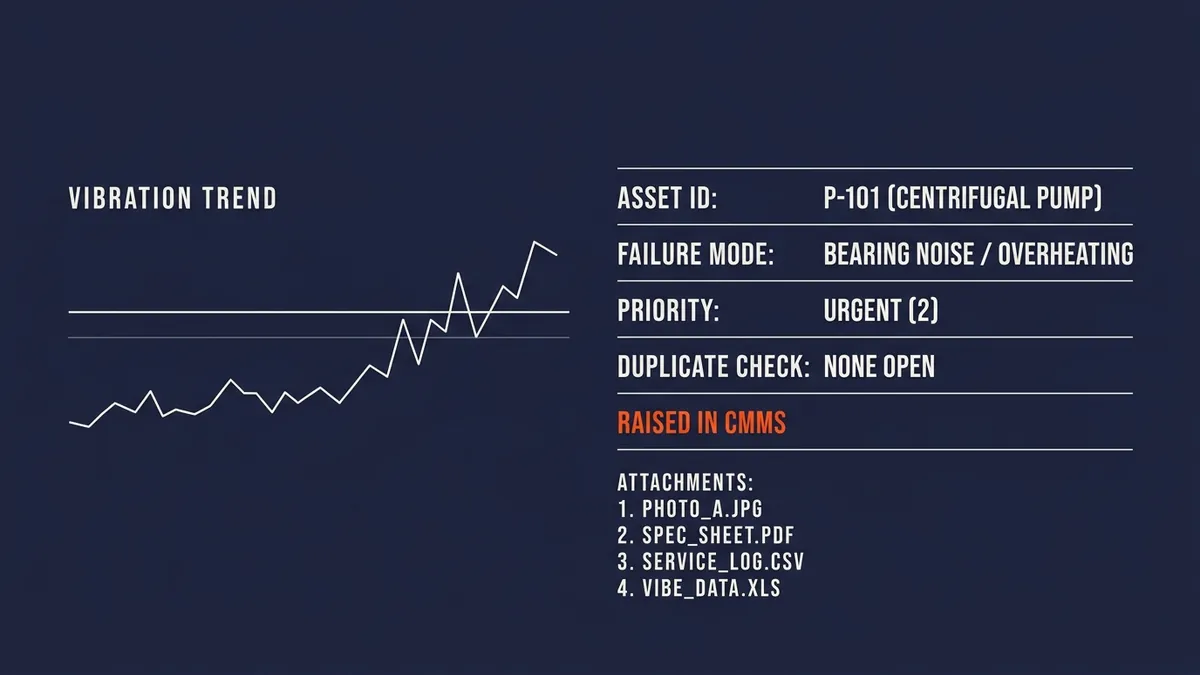
What this actually looks like today
A condition monitoring system flags a vibration trend. It appears on a dashboard. Someone notices, eventually. They cross-reference the asset in the CMMS, check whether a work order already exists, look up the last three interventions, decide priority, and raise it — badly coded, because they’re doing it between other tasks.
By the time it reaches the planner, the trend is two weeks old. Half of these never get raised at all.
What the agent does
- Trigger. A threshold breach, a trend deviation, an inspection note, or a technician’s voice report from the field.
- Reasoning. It pulls the asset’s maintenance history, checks for open or recently closed work orders on the same asset, weighs criticality against production schedule, and assesses whether this matches a known failure pattern.
- Action. Raises a correctly-coded work order in your CMMS with the asset, failure mode, priority, recommended intervention and supporting evidence attached.
- Escalation. Where the pattern is unfamiliar or criticality is high, it routes to a reliability engineer with the full reasoning trace rather than raising anything automatically.
Traditional vs agent-augmented
| Step | Today | With an agent |
|---|---|---|
| Anomaly detected | Appears on a dashboard | Triggers immediately |
| Someone notices | Hours to weeks | Not required |
| History cross-reference | Manual, often skipped | Automatic |
| Duplicate check | Rarely done | Always |
| Work order coding | Inconsistent by person | Consistent |
| Evidence attached | Rarely | Always, with the trace |
| Unfamiliar pattern | Guessed at | Escalated with reasoning |
Where we’ve built this
- Mining — technician voice reports from the field become structured work orders at the asset rather than reconstructed at end of shift
- Manufacturing — quality NCRs and maintenance signals correlated so recurring defects surface as asset problems
- Ports & Terminals — crane and yard equipment availability, where the verbal breakdown report never reached a system
- Oil, Gas & Utilities — asset health across distributed sites with intermittent connectivity
- Equipment Rental — off-hire inspection to work order, protecting utilisation and resale value
Systems we integrate with
- CMMS/EAM: SAP PM, IBM Maximo, Pronto, Mex, Fiix, Limble
- Historian and condition monitoring: read-only integration with PI, Aveva, and OEM condition platforms
- ERP: SAP, Pronto Xi, Dynamics
- Field capture: voice, mobile, offline-tolerant
How we de-risk it
- We do not touch control systems. Reads from historians are read-only. Nothing writes to a safety-rated system. Autonomous closed-loop control on those systems remains genuinely immature, and vendors claiming otherwise deserve scrutiny.
- Shadow mode first. The agent logs the work orders it would raise. Your planners compare against what they actually raised. You tune thresholds, then switch it on.
- Duplicate suppression is the first thing we test. The fastest way to lose planner trust is flooding the queue.
- Escalation over automation on unfamiliar patterns. An agent that raises a confident work order for a failure mode it has never seen is worse than one that asks.
What it typically costs
Single-asset-class deployment on a supported CMMS sits in the lower build bands, typically 4–8 weeks. Multi-site, multi-asset-class deployments run longer, and the integration to the historian is usually the long pole rather than the agent itself.
Frequently asked questions
Isn’t this what our condition monitoring system already does?
It detects. It doesn’t decide, code, deduplicate or raise. The gap between a dashboard alert and an actioned work order is where the value sits, and it’s almost always staffed by a human doing it inconsistently.
Will it flood our planners with work orders?
Duplicate suppression and criticality weighting are built and tested first, and shadow mode exists precisely so you can see the volume before it’s live.
Can it work with intermittent connectivity?
Yes. Field capture queues locally and reconciles when connectivity returns.
Does it need years of failure history to be useful?
No. It’s useful immediately on the coordination work — history lookup, deduplication, coding, evidence assembly — even before pattern-matching has much to learn from. Pattern quality improves with data.
Who is accountable for a missed failure?
You are, exactly as now. The agent improves detection-to-action time and creates a better evidence trail. It does not assume engineering accountability, and any vendor implying otherwise is selling you a liability problem.
Work out what this is costing you
The calculator takes ten inputs and shows the payback band. It won’t tell you whether your systems permit the integration — that’s what the audit tests.