> AI agents for mining and resources | DeityLabs
DeityLabs
Book the audit →

AI agents for mining and resources

The honest position: the highest-value AI agents in mining aren’t in the pit. They’re in the administrative layer around it — shift handovers, permits, maintenance records and rostering — where information currently moves by radio, WhatsApp and memory, and never reaches a system at all.

Last reviewed August 2026 · Sources cited inline

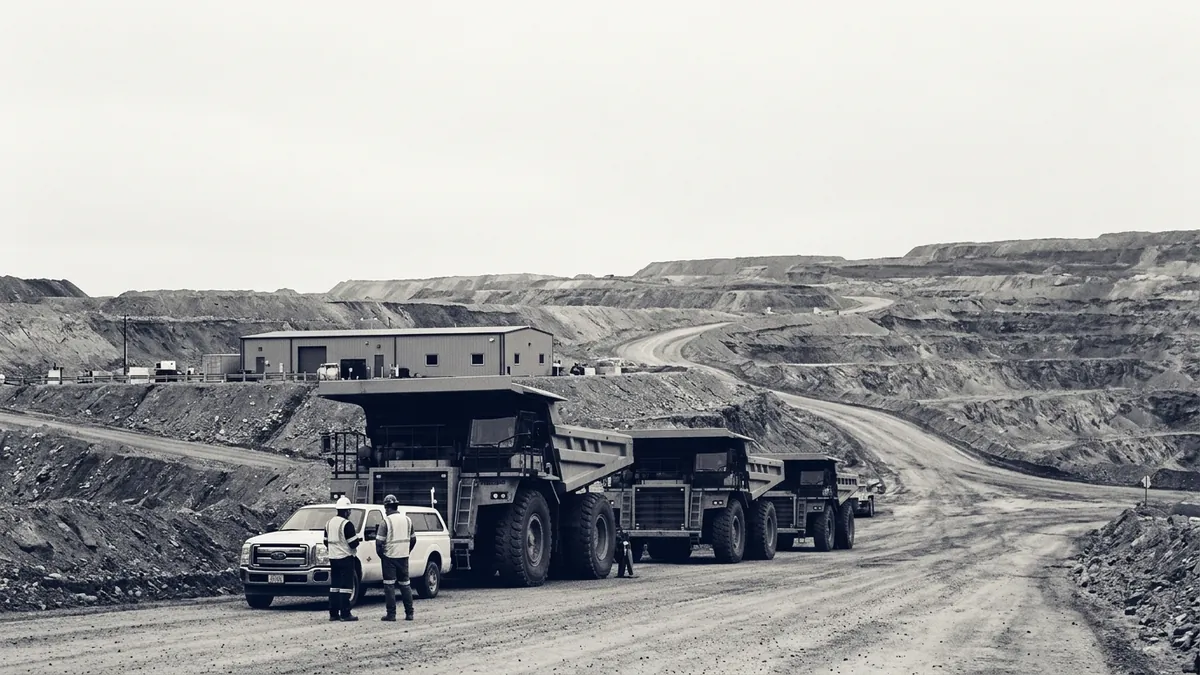
Haul trucks and two supervisors in high-visibility gear beside a site office at an open-pit mine

The problem nobody is selling into

Fleet management and process control are well covered. Vendors have been optimising haul cycles and plant performance for a decade. Competitors like XMPro are pushing multi-agent systems into industrial operations — but they target decision intelligence at the plant and fleet layer, not the verbal, undocumented coordination work that sits between shifts. Industrial AI vendors like ABB, Siemens and Rockwell Automation are similarly focused on process optimisation and control-system intelligence. On the contractor side, MyPass Global handles workforce compliance data but doesn’t capture the verbal handover or radio call-in that triggered the work. CMMS vendors themselves are adding AI — Fiix partnered with Augury to deliver predictive maintenance inside the CMMS, and IBM Maximo Health modules provide asset-performance analytics — but these are sensor-driven, plant-floor capabilities, not agents that sit in the verbal coordination layer between shifts.

What isn’t covered is everything that happens verbally. A substantial share of what determines equipment availability — shift handover notes, radio call-ins, verbal maintenance reports — travels by VHF radio, a message thread, or a verbal handover at shift change, and never lands anywhere queryable. Mining equipment maintenance costs run 20–40% of total operating costs (ResearchGate, 2022), yet much of the operational knowledge that drives availability decisions is never captured in a system. When something goes wrong three weeks later, the record doesn’t exist.

That’s the gap we build into.

What this costs you today

The administrative gap has a dollar figure — larger than most sites account for, because the cost is distributed across dozens of small losses that never appear on a single report.

$5,000–$20,000
Per hour idle · Heavy Vehicle Inspection, 2026

Downtime from undocumented issues

An ultra-class haul truck costs an estimated $5,000–$20,000 per hour idle (Heavy Vehicle Inspection, 2026). Mining operations lose an average of 8.7 days of unplanned downtime per haul truck annually (OxMaint, 2024). When a fault spotted on night shift never reaches the handover log, that truck can sit for an entire shift before the day crew finds it — a six-figure loss from a missing sentence.

30–50%
Downtime reduction · McKinsey, 2017

Maintenance overhead

McKinsey research on manufacturing analytics found that predictive maintenance typically reduces machine downtime by 30 to 50 percent and increases machine life by 20 to 40 percent (McKinsey, 2017). But it depends on complete, structured work-order data — and if technicians reconstruct orders from memory at end of shift, the data feeding your reliability program is incomplete by design. Lifetime maintenance expenses for heavy mining equipment can equal roughly 75% of a new machine’s cost (Grand View Research, 2023) — incomplete work-order data compounds that cost over the asset’s life.

90 days
To full compliance verification · Birchman, 2024

Contractor onboarding drag

Traditional onboarding can stretch to days of manual document chasing before a contractor can mobilise (Ideagen, 2024), and in complex shutdown scenarios up to 90 days for full compliance verification (Birchman, 2024). Every day waiting is a day of paid stand-down.

5 AUG 2025
GISTM conformance deadline · all remaining facilities

Compliance evidence gaps

ICMM members must conduct annual independent assurance of sustainability performance. The GISTM required conformance for extreme and very high consequence facilities by August 2023, and all remaining facilities by 5 August 2025. In Australia, the WHS (Mines) Regulations 2022 (WA) require every operator to implement a mine safety management system. Every paper log, every verbal handover, every undocumented radio call is a gap in the evidence chain these regimes demand.

Workflows we automate

Shift handover

What it is. An agent that captures outgoing-shift status by voice, structures it against your asset register, and delivers the incoming supervisor a briefing that names what changed, what’s still open, and what needs eyes first. The record is timestamped, searchable, and persisted — no more logbooks that get lost or left in a vehicle.
Who it’s for. Site supervisors, shift bosses, maintenance planners — anyone who has walked into a shift with nothing but a two-line WhatsApp message from the outgoing crew.
What you get. A searchable handover record, no handwritten log, and continuity when a supervisor is off-roster. Fatigue at shift change is a documented mining risk (Bauerle, 2018) — structured handovers reduce the cognitive load on an incoming supervisor already managing sleep debt. Open items from the handover feed downstream as work-order candidates and active isolations as permit-context.

Permit-to-work

What it is. An agent that pre-checks permit applications for completeness, validates against your isolation and hazard rules, flags conflicts with other active permits, and routes only exceptions to the authorised officer. It cross-references live isolation registers and contractor competency databases before submission.
Who it’s for. Safety and compliance leads, area supervisors, isolation officers.
What you get. Faster permit turnaround at shift start, a complete audit trail with timestamp and source for every decision, and fewer permits rejected at the gate because a field was missed. Permit-to-work digitisation is well-established as a safety and efficiency lever (Chen, 2023) — agents push it further by doing the pre-validation, not just storing the form. During shutdown periods when permit volumes spike, the agent scales without adding headcount.

Maintenance logs and work orders

What it is. An agent that takes voice or text from a technician in the field, writes a structured work order into your CMMS, attaches the right asset, and chases missing information — meter readings, fault codes, parts consumed — before the technician leaves the asset.
Who it’s for. Maintenance technicians, reliability engineers, planners.
What you get. Records captured at the point of work, not reconstructed at end of shift. Better data into your CMMS means better inputs to reliability programs, better failure-mode analysis, and fewer work orders closed with “no fault found” because the original description was a single word. The structured orders feed directly into predictive maintenance programs — SAP PM, Maximo Health or Fiix Asset Health — because data quality at source determines whether your reliability analytics work from real signal or noise.

Camp and roster management

What it is. An agent that handles FIFO roster queries, flight and accommodation changes, and swap requests, escalating only genuine conflicts — double-booked rooms, flight timing clashes, or roster-rule violations.
Who it’s for. Camp administrators, roster coordinators, HR.
What you get. The single largest source of repetitive inbound queries removed from your admin team. FIFO site admin roles are paid roles — every hour spent answering “what time is my flight?” is an hour not spent on coordination work that actually requires judgement. The agent also maintains an audit trail of roster decisions, which matters when a fatigue-related incident investigation asks why a worker was on their seventh consecutive night shift.

Contractor and vendor compliance

What it is. An agent that tracks certification expiry, chases documentation before a contractor mobilises, and blocks non-compliant site access requests. It cross-references your approved contractor database, insurance registers, and competency records continuously — not just at onboarding.
Who it’s for. Procurement, site access, HSE.
What you get. Compliance failures caught before the gate, not at it. Contractor onboarding that previously took days can be compressed to hours with automated verification (Ideagen, 2024) — and the agent keeps checking after onboarding, so a lapsed certification doesn’t go unnoticed for months. For shutdown mobilisation, where hundreds of contractors descend on a site in a compressed window, continuous verification prevents a compliance bottleneck at the gate.

Traditional workflow vs agent-augmented

Step Today With an agent
Shift handover Verbal, 10–20 min, undocumented Voice-captured, structured, searchable
Permit application Paper or PDF, queued at shift start Pre-validated, exceptions only
Work order creation Written at end of shift from memory Captured at the asset, in the moment
Roster query Phone call to camp admin Answered instantly, escalated if conflicting
Contractor cert check Manual spreadsheet review Continuous, blocking, automatic
Compliance evidence Paper logs, verbal confirmations Timestamped, sourced, queryable audit trail

What we integrate with

Agents sit above your existing stack and act through its APIs. We do not replace systems of record. Every platform below is verified as having an API our agents can call.

CMMS / EAM
SAP PM (S/4HANA PM via OData REST API), IBM Maximo (Maximo Integration Framework — REST APIs for assets, work orders and service requests), Pronto Xi (Pronto API framework, middleware integrations confirmed), MEX (web-based MEX API for assets, work orders, purchasing), Fiix (open REST API connecting PLCs, control systems, and sensors)
ERP
SAP, Pronto Xi, Microsoft Dynamics
SCADA / historians
Read-only integration with SCADA/DCS historians via OPC UA where appropriate — agents read historian data for context, they never write to control systems
FMS
Overlay on existing FMS rather than replacement
Comms
Teams, radio-to-text gateways, SMS, WhatsApp Business

If an agent can’t reach your systems of record, it can answer questions but it can’t complete work. Integration depth is the line between a pilot and something that runs the site.

How we de-risk it

Safety-critical boundaries

Agents do not touch safety-rated control systems. Autonomous closed-loop control on those systems remains genuinely immature, and any vendor claiming otherwise deserves scrutiny. We build in the administrative and coordination layer.

Shadow mode first

Every agent runs alongside your team for an agreed period, logging what it would have done. You compare, then you switch it on.

Connectivity

Remote sites drop out. Agents queue and reconcile rather than failing.

Your infrastructure

Everything runs in accounts you own. You can end the relationship and keep the system.

Human escalation by design

Low confidence routes to a person with full context, not a dead end.

Regulatory evidence

Every agent action is logged with timestamp, source and confidence — the kind of evidence ICMM assurance, GISTM conformance and WHS mine safety management systems expect. Agents produce records; they don’t replace accountability.

Where we’d start

If you’re running one site or a portfolio, start with shift handover. It’s the workflow where the administrative gap is widest, the data loss is most frequent, and the agent delivers visible value within the first shadow-mode cycle — because every supervisor sees the difference between “what the outgoing crew told me verbally” and “what the system handed me.” It also produces the cleanest before/after evidence for your HSE and compliance teams, since the handover record is something regulators already expect to exist but rarely find in queryable form.

Once handover is stable, the same agent framework extends naturally to maintenance logs (the handover already references work orders) and permit pre-validation (the handover already references active isolations). Shift handover is the keystone — it connects to everything else.

Our engagement process

  1. 01

    Audit — 5 days, fixed price

    We map every candidate workflow, rank by hours recovered and risk, and give you a build estimate per workflow.

  2. 02

    Scope and fix price

    You pick the first workflow. We quote it fixed.

  3. 03

    Build — typically 4–8 weeks

    Working demo every Friday.

  4. 04

    Shadow mode — 2 weeks

    Validation against live operations.

  5. 05

    Go live, then AgentOps

    Monitoring, evals and expansion on retainer.

Book the audit → Estimate your recoverable cost →

When not to hire us

  • —If your site doesn’t have a CMMS or ERP with an API, we can’t integrate — you need to fix that first.
  • —If you’re looking for autonomous control of safety-rated systems, that’s not what we build. Look elsewhere.
  • —If your operation is small enough that one supervisor handles every shift and knows everything by memory, the administrative gap may not exist yet.
  • —If your procurement process can’t accommodate a 5-day fixed-price audit before a build quote, we’re not the right fit.

Workflows in detail

Each of these is written up on its own, with the integration detail and the boundaries.

Shift handover agents →Permit-to-work agents →Maintenance log agents →

Related use cases

The same workflows, described by the job rather than the sector.

Shift handover →Compliance reporting →Predictive maintenance →Vendor compliance →

Frequently asked questions

Can an AI agent operate on a site with no reliable connectivity?

Yes. Agents are built to queue locally and reconcile when connectivity returns. Voice capture, work-order creation and handover logging all function offline.

Will this touch our control systems?

No. We build in the administrative and coordination layer. Safety-rated control systems are out of scope by design. Agents read SCADA/DCS historian data via OPC UA for context only — they never write to control systems.

How do we prove it worked before trusting it?

Shadow mode. The agent runs alongside your team logging its intended actions without executing them. You review the log, then authorise it.

What about ICMM, WHS and site-specific compliance obligations?

Agents improve compliance evidence rather than replacing accountability. Every action is logged with a timestamp, source and confidence score, which is stronger evidence than a paper log. ICMM Mining Principles require annual independent assurance of sustainability performance; GISTM conformance deadlines hit all remaining ICMM member facilities by 5 August 2025. In Australia, WHS Mines Regulations require a documented mine safety management system — agents produce the records that system needs.

Who owns the data?

You do. Agents run in your cloud accounts, against your data, under your access controls.

How long until the first agent is live?

Typically 6–10 weeks from audit sign-off, including shadow-mode validation.

Can the agent write work orders directly into SAP PM or Maximo?

Yes. Both SAP PM (via OData REST) and IBM Maximo (via the Maximo Integration Framework) expose APIs that support work-order creation, asset attachment, and status updates. The agent writes through your existing API — it doesn’t bypass your validation rules or approval workflows.

What happens if the agent gets something wrong in a permit-to-work check?

The agent pre-checks and flags — it does not approve. Every permit still routes to the authorised officer for sign-off. If the agent’s pre-validation is wrong (false positive or false negative), the officer sees both the agent’s flag and the source data, and makes the call. The agent reduces the queue, not the accountability.

Does this work for underground mines as well as open-pit?

Yes. The administrative workflows — handover, permits, work orders, contractor compliance — exist in both environments. Underground operations often have stricter isolation and permit requirements, which makes pre-validation more valuable, not less. Connectivity constraints underground are handled by the same queue-and-reconcile approach.

Can agents support shutdown and turnaround maintenance?

Yes. Shutdowns are the highest-volume permit and work-order activity on a mine site. The agent pre-validates permits against isolation rules and competency records at scale, captures work orders from technicians during execution, and produces the compliance evidence package shutdown audits require — without adding headcount.

Do agents replace our fleet management system?

No. Your FMS handles haul cycle optimisation and payload monitoring. Agents overlay it — the handover notes a truck is down, the work order captures the fault code, the permit authorises the isolation. Fleet management tells you what the truck is doing; the agent records what the crew did about it.

How do agents handle multi-site or portfolio operations?

Agents are deployed per site but share a common framework. Site-specific rules, asset registers and compliance regimes are configured per location, but the handover structure, work-order schema and audit trail remain consistent across sites — giving portfolio operators comparable reporting without forcing identical processes.

What’s the difference between an AI agent and our SCADA/DCS analytics?

SCADA and DCS analytics monitor process variables — temperature, pressure, vibration — and trigger alarms when thresholds are breached. Agents operate at the administrative layer: when a SCADA alarm fires, the agent creates the work order, logs the incident and checks whether the relevant isolation permit is still valid. SCADA tells you something happened; the agent handles the paperwork that follows.

How is this different from what XMPro or other industrial AI vendors offer?

XMPro builds agentic AI for industrial decision intelligence — sensor-driven, plant-floor, multi-agent systems with 150+ OT/IT connectors. ABB, Siemens and Rockwell target process control and predictive analytics at the plant layer. MyPass handles contractor compliance data. We build for the administrative layer: verbal workflows, permits, maintenance logs, roster queries. Different layer, different buyer.

Can agents work with our legacy paper-based systems during transition?

Yes. The agent can capture data at the source — voice, text, radio-to-text — and write to your CMMS or ERP where an API exists, while producing a parallel structured record for any workflow still on paper. Sites transitioning from paper logs to a digital CMMS can run the agent alongside both: the agent creates the digital record immediately, even if the paper log is still being maintained for interim compliance.