AI agents for scheduling and dispatch
Straight answer: the schedule isn’t the problem. The schedule survives contact with reality for about ninety minutes. The problem is the constant re-optimisation nobody has time to do properly, which is why dispatchers are the most interrupted people in most operations.
Last updated:
What this actually looks like today
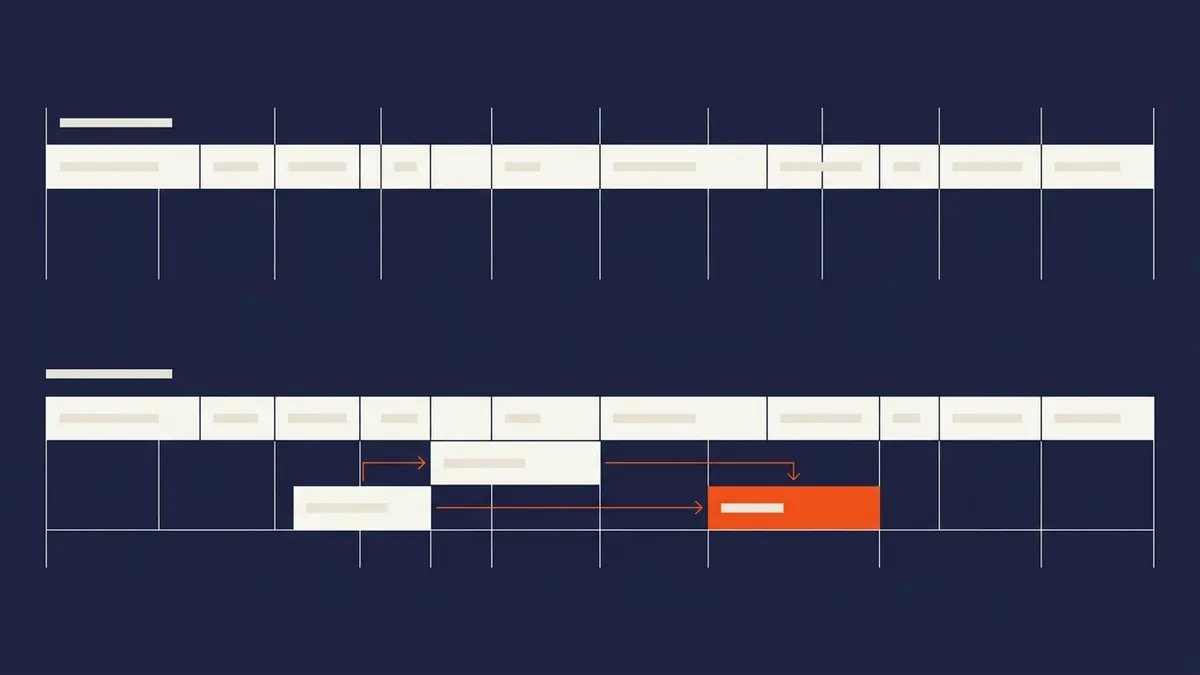
A job overruns. A tech calls in sick. A customer cancels at 8am. Each event triggers a cascade: who can cover, what moves, who needs telling, does the parts run still work.
A dispatcher holds this in their head and resolves it badly under time pressure, because doing it well would take twenty minutes and they have four minutes. The cost isn’t the dispatcher’s salary — it’s the utilisation lost on every suboptimal decision, multiplied by every disruption, every day.
What the agent does
- Trigger. A cancellation, an overrun, a sick call, a new emergency, a parts delay, a traffic event.
- Reasoning. Evaluates skills, certifications, location, travel time, SLA commitments, parts availability and roster rules against every affected job.
- Action. Re-sequences the day, reassigns where permitted, notifies affected customers and technicians, and updates the field service platform.
- Escalation. Where reassignment breaks an SLA, a certification requirement, or a customer commitment, it presents ranked options to the dispatcher rather than choosing.
Traditional vs agent-augmented
| Event | Today | With an agent |
|---|---|---|
| Job overruns 90 min | Discovered when next customer calls | Detected, downstream jobs resequenced |
| Tech calls in sick | Manual scramble at 6am | Coverage options ranked before anyone’s awake |
| Customer cancels | Slot lost | Backfilled from the waiting list |
| Emergency arrives | Something gets bumped, badly | Least-cost disruption calculated |
| Customer asks “where are they?” | Interrupts dispatcher | Answered from live job status |
Where we’ve built this
- Home Services & Trades — the highest-disruption environment there is
- Freight & Logistics — load reassignment and driver comms
- Aged Care & Disability — carer matching against client preference, continuity and funding rules
- Security & Guarding — shift coverage against licensing requirements
Systems we integrate with
- Field service: ServiceM8, simPRO, ServiceTitan, Jobber, Tradify, Housecall Pro
- Rostering: Deputy, Humanity, UKG
- Routing: existing optimisation engines, extended rather than replaced
- Comms: SMS, WhatsApp, push, voice
How we de-risk it
- Constraints are hard, not soft. Certification, licensing and safety requirements are enforced as absolute rules, never traded off against efficiency.
- Reassignment permissions are explicit. You decide what the agent may move autonomously and what it must ask about. Most clients start with notify-only.
- Shadow mode shows you the alternative day. For two weeks the agent logs the schedule it would have produced. You compare utilisation against what actually happened.
Frequently asked questions
Won’t technicians resent an algorithm assigning their work?
They resent it when it’s opaque and when it ignores real constraints. Every assignment carries its reasoning, and hard constraints stay hard. Involve the crew in defining the rules and this lands well.
Does it replace our routing software?
No. It sits above it and handles the decisions routing engines don’t make — who, whether, and what to tell people.
What about union or EBA rostering rules?
Encoded as hard constraints. If it can’t satisfy them it escalates rather than proposing something non-compliant.
How does it handle customer preference for a particular tech?
As a weighted preference you set. In aged care, continuity is usually weighted very high.
Work out what this is costing you
The calculator takes ten inputs and shows the payback band. It won’t tell you whether your systems permit the integration — that’s what the audit tests.